The Process
How the money actually moves, the rule HUD changed three weeks ago because contractors were walking off jobs, and what goes wrong, told straight.
Watch the lesson
Prefer reading? The full module is below, same content, same sources.
What you will learn
What you'll be able to do
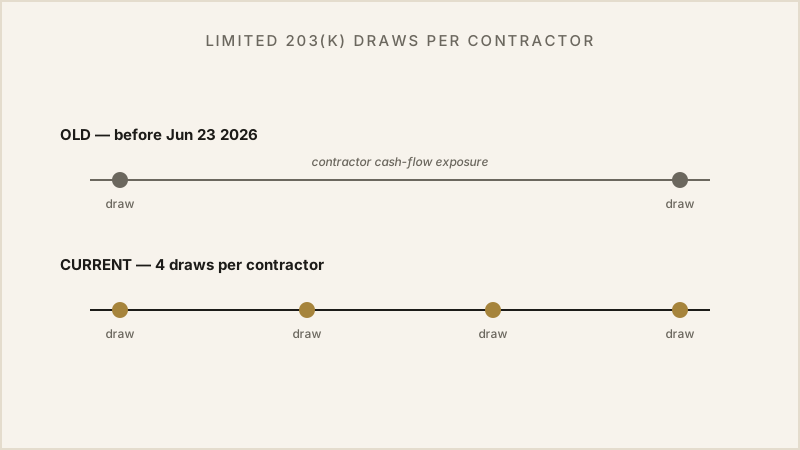
- Describe the draw structure, 4 draws per contractor on a Limited since ML 2026-06 (eff. June 23 2026), up from 2, and explain why HUD changed it.
- State the $15,000 inspection threshold on a Limited.
- State the five-business-day lender funding rule after a properly executed draw request.
- Anticipate the common failure modes (contractor walk-off, scope creep, consultant scheduling, appraisal shortfall).
Read the lesson
THE BIG IDEA
Plan the work and the payments together.
- Renovation funds move through escrow and draws.
- Complete paperwork matters to payment timing.
- Track scope, scheduling, cash flow, and value.
Read one section at a time. Then explain the idea in your own words.
How the money actually moves
At closing, two things happen at once. The purchase money goes to the seller, and that part looks like any other sale. The renovation money does not go to you. It goes into an escrow account, and it is released in stages called draws, as work is completed and verified.1
That single fact drives almost everything else in this module.
You have a clock, too. The rehabilitation period is nine months on a Limited and twelve months on a Standard. HUD's language is "not to exceed" those figures.1 That is not a suggestion; it is in the Rehabilitation Loan Agreement you sign, and that agreement is incorporated into your security instrument.
So the shape of it: money in escrow, released against completed work, on a defined clock, with someone verifying at each step.
The rule that changed three weeks ago
This is the most current thing in the entire course, and most of the industry has not caught up to it.
The number: On a Limited, a lender "may approve a maximum of four draw requests per contractor or for the Borrower (if acting as the contractor)."2 On a Standard, the maximum is five: four intermediate plus one final.2 Confirm it for your file: ML 2026-06 was issued June 23, 2026 and was effective immediately. If your lender describes a two-draw limit, they are working from the old rule. That letter is your citation.
It used to be two. And HUD's explanation of why it changed is the most honest paragraph in the 203(k) rulebook:
The two-draw limit "does not align with the higher total rehabilitation costs now permitted. Specifically, Mortgagee feedback notes that this limitation disrupts contractor cash flow, which increases the risk of delays and in some instances project abandonment."2
Read what that admits. When the cap rose to $75,000 in 2024, the draw structure did not move with it, so contractors were being asked to carry a $75,000 job on two payments. Many could not. They walked off, and HUD watched it happen for eighteen months before fixing it in June 2026.
The practical read: the Limited 203(k) only became genuinely workable last month. If someone tells you "203(k) is a nightmare, contractors always bail," they are describing a real experience, under a rule that no longer exists. That is not a reason to dismiss them. It is a reason to know the date.
One useful subtlety: a draw may include up to two separate disbursements, and still counts as one draw.2 So four draws is not as tight as it sounds. There is room to pay for materials and labor separately within a single draw.
Inspections and the five-day rule
Two mechanics that shape your timeline:
The number: On a Limited, when total repair costs are $15,000 or less, the lender may confirm the work is done using contractor's receipts or a signed Borrower's Letter of Completion, with no inspection required. Above $15,000, an inspection is required.2 Confirm it for your file: the lender may still choose to inspect for its own risk purposes even under the threshold. This tells you what is required, not what your lender will do.
The number: "The Mortgagee must release funds within five business days after receipt of a properly executed draw request and title update when necessary."2 Confirm it for your file: the words doing the work are properly executed. An incomplete request does not start the clock.
That five-day rule is worth knowing precisely because your contractor is planning payroll around it. If a draw is sitting for two weeks, something is wrong, and now you know it is not supposed to be normal.
The flip side, said plainly: most draw delays are paperwork, not malice. A missing signature, an incomplete request, a title update nobody ordered. The buyers who sail through are the ones who treat draw requests as a deadline they own rather than something that happens to them.
What actually goes wrong
No flinching here. These are the four ways a 203(k) actually fails, in rough order of frequency.
1. The contractor cannot carry the float, and walks. The one HUD itself named. They buy materials, they make payroll, and then they get paid. A business that cannot absorb weeks of cost stops working, usually around the moment your kitchen has no cabinets. Then you are hiring a replacement at emergency prices, with a nine-month clock running and your money still in escrow. This is why Module 4 pushed so hard on asking a contractor directly whether they can float between draws. The four-draw rule helps. It does not eliminate the problem.
2. Scope creep. You are standing in the house. The tile is out. It seems obvious to just do the hallway too. Every change is a change order, every change order costs $120 if a consultant is involved, and each one moves your timeline. Worse, scope added mid-project competes with the contingency reserve you set aside for genuine surprises. Spend contingency on discoveries, not on upgrades. The house will offer you plenty of discoveries.
3. Consultant scheduling. Sixty of them in California. On a Standard you cannot close without one, and you cannot draw without their inspections. A consultant with a three-week queue is a three-week delay you did not plan. Find yours early.
4. Appraisal shortfall. The after-improved appraisal comes in under what your scope assumed, and the 110% test bites (Module 3, where the figure is 100% if you are buying a condominium). Now the loan cannot be built on your acquisition cost, and you are cutting scope or bringing cash, late, under pressure. This is the argument for scoping against real comparable sales before you offer, rather than pricing a wish list and hoping the appraiser agrees.
Notice what is not on this list: the government cancelling your program, your rate moving, the loan being withdrawn. Those are not the risks. The risks are cash flow, discipline, scheduling, and value, and every one of them is more manageable if you saw it coming.
That is the entire purpose of this course. Not to promise you it goes smoothly. To make sure that when it gets hard, it gets hard in a way you already recognize.
PAUSE & RECALL
Try it on a home.
The work is finished, but the contractor is still waiting for a draw. What would you check first?
Compare your answer
Check whether the required request, verification, and any title update are complete. Find the missing step before assuming that completion of the work alone starts the payment clock.
References for this lesson
-
HUD Mortgagee Letter 2024-13, "Revisions to the 203(k) Rehabilitation Mortgage Insurance Program including updates to the 203(k) Consultant Requirements and Fees," July 9 2024, effective for case numbers assigned on or after November 4 2024. https://www.hud.gov/sites/dfiles/OCHCO/documents/2024-13hsgml.pdf (full text retrieved and searched 2026-07-16) ↩↩
-
HUD Mortgagee Letter 2026-06, "Increase in the Maximum Number of Draw Requests for Limited 203(k) Rehabilitation Mortgage Insurance Program," June 23 2026, effective immediately. https://www.hud.gov/sites/default/files/hudclips/documents/2026-06hsgml.pdf (full text retrieved and searched 2026-07-16) ↩↩↩↩↩↩
Check yourself
Loading the knowledge check…
Sources and dates
Sources
- HUD Mortgagee Letter 2026-06, Increase in the Maximum Number of Draw Requests for Limited 203(k). https://www.hud.gov/sites/default/files/hudclips/documents/2026-06hsgml.pdf (VERIFIED, retrieved 2026-07-16)
- HUD Mortgagee Letter 2024-13, Revisions to the 203(k) Rehabilitation Mortgage Insurance Program. https://www.hud.gov/sites/dfiles/OCHCO/documents/2024-13hsgml.pdf (VERIFIED, retrieved 2026-07-16)