What a 203(k) actually is
One loan buys the home and pays for the work, and it is underwritten against the house you are going to build, not the one you are walking through.
Watch the lesson
Prefer reading? The full module is below, same content, same sources.
What you will learn
What you'll be able to do
- Explain how a 203(k) differs from a standard mortgage. It is underwritten against the after-improved value, not the as-is condition.
- Identify the three components combined into one loan amount (purchase price + renovation budget + contingency reserve).
- Recall that FHA allows a minimum 3.5% down, applied to the total project cost, not just the purchase price.
- Distinguish FHA 203(k) from Fannie Mae HomeStyle Renovation at a high level.
- Recognize that FHA 203(k) itself requires no homebuyer education, and that state or DPA programs may impose their own.
Read the lesson
THE BIG IDEA
One purchase. One renovation plan.
- The purchase and the renovation belong in the same plan.
- The finished home’s value matters to the financing.
- Use the lesson to prepare questions for your lender.
Read one section at a time. Then explain the idea in your own words.
The loan that sees the finished house
A normal mortgage is a loan against the house as it stands today. If the kitchen is from 1974 and the bathroom tile is cracked, the lender sees a 1974 kitchen and cracked tile, and lends accordingly.
That leaves you in a loop with no exit. The homes you can afford need work. The work costs money you do not have yet. And no lender will fund work on a house you do not own.
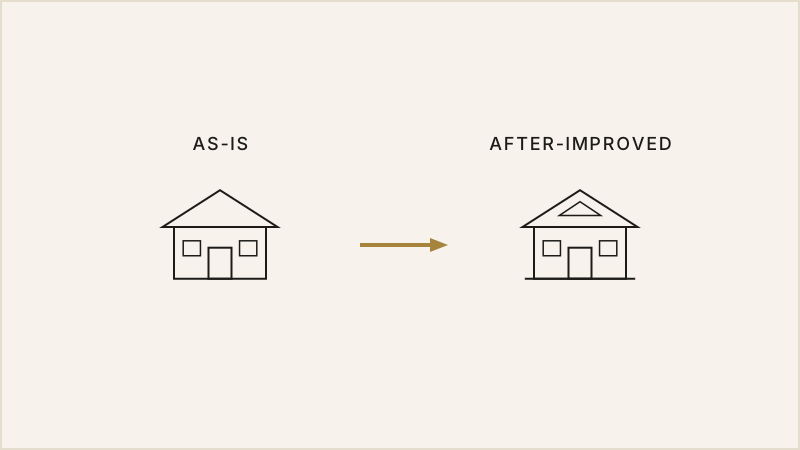
An FHA 203(k) breaks the loop. It is a government-backed mortgage that finances the purchase and the renovation together, and it is underwritten against what the home will be worth after the improvements are complete.1
The lender is looking at the house you are going to build, not the one you are walking through.
That is the entire idea. Everything else in this course is mechanics.
What goes into the one loan
Three things are added together to make your loan amount:
- The purchase price: what you pay the seller.
- The renovation budget: the actual scope, priced by a licensed contractor. Not a guess.
- The contingency reserve: a required cushion for what an old building is hiding behind its walls.
That total is then tested against the after-improved appraised value. How it works start to finish:
- You find a home that needs work, and you build a scope: the real list of what gets done, priced.
- An appraiser values the home as improved, using that scope. This is the number the loan leans on.
- Purchase price, renovation budget, and contingency reserve combine into one loan amount.
- You close. Purchase funds go to the seller. Renovation funds go into an escrow account and are released to your contractor in stages as work is completed.2
- The work gets done. You move into a finished home with one mortgage payment.
The contingency reserve is the line people try to argue down, and it is the line you should not touch. A house built in 1965 has opinions it has not shared with you yet.
Because it is FHA
The 203(k) sits inside the FHA family, and that is what makes it reachable. FHA allows a minimum down payment of 3.5% for qualifying borrowers.1
Here is the part most people get wrong, and it cuts both ways:
The number: On a 203(k), that 3.5% is applied to the total project cost (purchase plus renovation plus contingency), not just the purchase price. Confirm it for your file: your exact loan amount is set by a max-mortgage worksheet with several tests in it. Ask your lender to run yours. What you should not accept is being told the down payment is 3.5% of the sticker price alone.
So the down payment is a bigger number than the listing suggests. In exchange, you are buying a finished house, and you are financing the work at mortgage rates over mortgage timelines instead of on a credit card.
Because it is FHA, the loan also carries mortgage insurance, and there are program requirements that come with it. Those factors, and today's rates, are your lender's column. We will not quote you a rate in this course, and you should be skeptical of anyone who quotes one before seeing your file.
The conventional sibling
If you qualify conventionally, Fannie Mae HomeStyle Renovation does something very similar outside the FHA system: one loan for purchase and renovation, appraised on the finished result.3
Two doors into the same house. They have different qualifying rules, different insurance treatment, and different paperwork. Which door is open to you depends on your credit profile and your project, and that is a real conversation to have, not a coin flip.
Nobody is making you take this course
Worth saying plainly, because it shapes how you should use everything here:
The number: FHA 203(k) has no homebuyer education requirement. We searched the current 203(k) rulemaking end to end. The word "education" does not appear in it.2 HUD's own 203(k) program page imposes no such condition either.1
So this course is not a hoop. It is not a course you are required to take. It exists because this product is badly explained, not because anyone requires you to sit through it.
Two honest caveats:
- Your specific program might have its own rule. State housing finance agencies and down-payment assistance programs frequently require homebuyer education for the money they provide. That is their requirement, not FHA's. If a program you are using requires homebuyer education, take the course from the provider that program names. This course is not a substitute for it.
- Finishing this course earns a completion card, and that is all it is. It is not accredited and it does not satisfy anyone's requirement.
What it will do is make you the most informed person in the room about a loan that most of the industry has quietly stopped offering. That turns out to be worth more than any piece of paper.
PAUSE & RECALL
Try it on a home.
A home needs a kitchen before you can move in. What should you understand before deciding whether to buy it?
Compare your answer
Explain the repair scope, the total project budget, and the expected value after the work. Ask your lender to test the actual file.
References for this lesson
-
HUD, "203(k) Rehabilitation Mortgage Insurance Program." https://www.hud.gov/hud-partners/single-family-mortgage-programs-203k (retrieved 2026-07-16) ↩↩↩
-
HUD Mortgagee Letter 2024-13, "Revisions to the 203(k) Rehabilitation Mortgage Insurance Program including updates to the 203(k) Consultant Requirements and Fees," July 9 2024, effective for case numbers assigned on or after November 4 2024. https://www.hud.gov/sites/dfiles/OCHCO/documents/2024-13hsgml.pdf (full text retrieved and searched 2026-07-16) ↩↩
-
Fannie Mae, "HomeStyle Renovation mortgage." https://yourhome.fanniemae.com/buy/homestyle-renovation (retrieved 2026-07-16; direct fetch blocked, confirmed via search index, with claims kept high-level) ↩
Check yourself
Loading the knowledge check…
Sources and dates
Sources
- HUD, 203(k) Rehabilitation Mortgage Insurance Program. https://www.hud.gov/hud-partners/single-family-mortgage-programs-203k (VERIFIED, retrieved 2026-07-16)
- HUD Mortgagee Letter 2024-13, Revisions to the 203(k) Rehabilitation Mortgage Insurance Program. https://www.hud.gov/sites/dfiles/OCHCO/documents/2024-13hsgml.pdf (VERIFIED, retrieved 2026-07-16)
- Fannie Mae, HomeStyle Renovation mortgage. https://yourhome.fanniemae.com/buy/homestyle-renovation (SUPPORTED, retrieved 2026-07-16)