Limited vs Standard
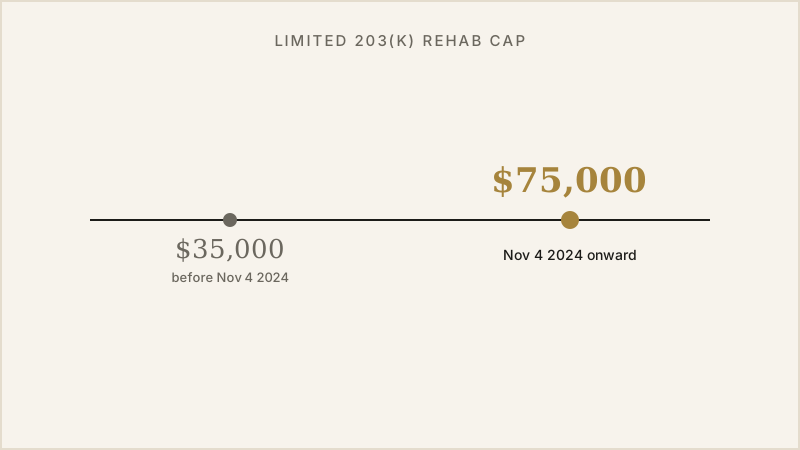
Two versions of the same loan. The cap is $75,000, not the $35,000 half the internet still quotes, and your scope, not your preference, decides which path you are on.
Watch the lesson
Prefer reading? The full module is below, same content, same sources.
What you will learn
What you'll be able to do
- State the current Limited 203(k) rehab cap ($75,000, ML 2024-13, eff. Nov 4 2024) and recognize that the widely-quoted $35,000 is superseded.
- Identify the four triggers that force a deal out of Limited and into Standard.
- Determine whether a HUD 203(k) Consultant is required for a given path (Standard yes, Limited optional).
- Select the correct path for a given scope and budget.
Read the lesson
THE BIG IDEA
Start with the work the house needs.
- Define the repair scope before choosing a loan path.
- Compare the work, timeline, and payment schedule.
- Check the rules and dates with your lender.
Read one section at a time. Then explain the idea in your own words.
The cap everyone gets wrong
There are two 203(k)s. Same idea, two sizes: Limited and Standard.
Limited is the smaller, faster one. It is built for cosmetic-to-moderate work: kitchens, baths, flooring, paint, systems, roofs. And it has a ceiling:
The number: A Limited 203(k) finances up to $75,000 in total rehabilitation cost.1 Confirm it for your file: the cap is reviewed annually alongside FHA's loan limits, and the date your case number is assigned governs which rules apply. Ask your lender to confirm against your file.
Now the part that will save you an argument.
That cap used to be $35,000, and half the internet still says so. It was raised to $75,000 by Mortgagee Letter 2024-13, effective for case numbers assigned on or after November 4, 2024.1 The old number is still sitting on lender web pages, in articles, in printed handouts, and in a lot of loan officers' heads.
This is not a reason to be smug about it. 203(k) is a sliver of most originators' business, and stale figures are an honest mistake. But it is a reason to know the number yourself. If you are told $35,000, you are being quoted a cap that has been dead since 2024, and a $40,000 difference decides whether the house you are standing in is buyable.
For 2026, $75,000 stands. The letter that sets the 2026 loan limits contains no 203(k) increase.3
Two more things ML 2024-13 changed that are worth pocketing:
- Energy improvements can be financed in addition to the $75,000 cap.1 Insulation, windows, and efficiency work do not have to eat your budget.
- The Consultant's fee can now be financed into the mortgage.1 It used to be cash out of your pocket. On a Limited, where a Consultant is optional, this quietly makes hiring one much more attractive.
What forces you into Standard
Here is the mental shift that makes this module click: you do not choose your path. Your scope chooses it.
A project moves out of Limited and into Standard when the work:1
- Takes more than nine months. Nine months is the Limited rehabilitation period. Standard gets twelve.
- Needs more than four draws per contractor. More on draws below. This one changed three weeks ago.
- Comes out of the appraisal and requires a Consultant work write-up or plans and architectural exhibits. Translation: if it needs drawings, it is Standard.
- Displaces you from the home for more than 30 days total.
Anything structural lands you on Standard too. That is what the architectural-exhibits trigger is really describing.
The draw rule that just changed
The number: On a Limited, a lender may approve a maximum of four draw requests per contractor (or for you, if you are acting as the contractor). This went from two to four on June 23, 2026, and it was effective immediately.2 A Standard is unchanged at five (four intermediate plus one final).2 Confirm it for your file: this letter is weeks old. If your lender is working from the two-draw rule, point them to ML 2026-06.
Why this matters more than it sounds: draws are how your contractor gets paid. HUD raised the limit because two draws were not enough to keep a contractor solvent through a $75,000 job. HUD said so directly. The old limit "disrupts contractor cash flow, which increases the risk of delays and in some instances project abandonment."2
That is HUD conceding, on the record, that the program was built in a way that made contractors walk off jobs. They raised the money in 2024 and fixed the plumbing in June 2026. The Limited only became genuinely workable in the last month, which is exactly why so few people around you have run one recently.
The Consultant
The number: A Standard 203(k) requires a HUD-approved 203(k) Consultant. A Limited does not, but you may use one, and the fee can now be financed.1
Standard also gets one thing Limited does not: a financeable Mortgage Payment Reserve of up to twelve months of payments, for the period the house cannot be occupied.1 If you are paying rent while your house is a construction site, that line matters enormously.
Choosing your path
| Limited | Standard | |
|---|---|---|
| Rehab cost ceiling | $75,0001 | Bounded by your loan limit and the value tests, not a flat rehab cap |
| Rehabilitation period | 9 months1 | 12 months1 |
| HUD Consultant | Optional (fee financeable)1 | Required1 |
| Draws | Max 4 per contractor2 | Max 5 (four intermediate + one final)2 |
| Structural work | No | Yes |
| Displacement | Up to 30 days1 | Longer, with a financeable payment reserve1 |
Read that table as a diagnosis, not a menu. Price the work the house actually needs, then see which column it lands in.
The failure mode to avoid: shaving a real scope down to squeeze under $75,000 or under nine months so you can stay on a Limited. That is how people end up living in a house with the expensive problem still in it and no financing left to fix it. If the house needs structural work, Standard exists for exactly that. It is more process, not a punishment.
And the reverse is just as true. If your scope is a kitchen, two baths, and floors, do not let anyone talk you into the heavier path. Limited is faster, needs no Consultant, and since June 2026 it finally pays your contractor on a schedule they can survive.
PAUSE & RECALL
Try it on a home.
Why could two homes with similar asking prices need different renovation-loan paths?
Compare your answer
The work can be different. Structural repairs, the time required, and the other scope requirements affect the path; asking price alone does not decide it.
References for this lesson
-
HUD Mortgagee Letter 2024-13, "Revisions to the 203(k) Rehabilitation Mortgage Insurance Program including updates to the 203(k) Consultant Requirements and Fees," July 9 2024, effective for case numbers assigned on or after November 4 2024. https://www.hud.gov/sites/dfiles/OCHCO/documents/2024-13hsgml.pdf (full text retrieved and searched 2026-07-16) ↩↩↩↩↩↩↩↩↩↩↩↩↩↩
-
HUD Mortgagee Letter 2026-06, "Increase in the Maximum Number of Draw Requests for Limited 203(k) Rehabilitation Mortgage Insurance Program," June 23 2026, effective immediately. https://www.hud.gov/sites/default/files/hudclips/documents/2026-06hsgml.pdf (full text retrieved and searched 2026-07-16) ↩↩↩↩↩
-
HUD Mortgagee Letter 2025-23, "2026 Nationwide Forward Mortgage Loan Limits," December 11 2025. https://www.hud.gov/sites/dfiles/hudclips/documents/2025-23hsgml.pdf (cited for the absence of any 203(k) cap increase for 2026; retrieved 2026-07-16) ↩
Check yourself
Loading the knowledge check…
Sources and dates
Sources
- HUD Mortgagee Letter 2024-13, Revisions to the 203(k) Rehabilitation Mortgage Insurance Program. https://www.hud.gov/sites/dfiles/OCHCO/documents/2024-13hsgml.pdf (VERIFIED, retrieved 2026-07-16)
- HUD Mortgagee Letter 2026-06, Increase in the Maximum Number of Draw Requests for Limited 203(k). https://www.hud.gov/sites/default/files/hudclips/documents/2026-06hsgml.pdf (VERIFIED, retrieved 2026-07-16)
- HUD Mortgagee Letter 2025-23, 2026 Nationwide Forward Mortgage Loan Limits. https://www.hud.gov/sites/dfiles/hudclips/documents/2025-23hsgml.pdf (VERIFIED, retrieved 2026-07-16)