The Money
What you actually bring, what the loan is sized against, the ceiling you cannot see, and the difference between value you created and value you waited for.
Watch the lesson
Prefer reading? The full module is below, same content, same sources.
What you will learn
What you'll be able to do
- Calculate a 3.5% down payment on total acquisition cost.
- Explain the 110% of after-improved value test and why it can become the binding constraint.
- Explain the contingency reserve, what it is for and why an old building needs a bigger one.
- State the 2026 LA County FHA limits, 1-unit $1,249,125 through 4-unit $2,402,625.
- Describe UFMIP and annual MIP in plain language, without quoting rates or factors.
- Distinguish forced appreciation (value you created) from speculation (value you waited for).
Read the lesson
THE BIG IDEA
Budget for the whole project.
- Separate purchase price from total project cost.
- Keep a cushion for surprises.
- Check the budget against the value tests and loan limits.
Read one section at a time. Then explain the idea in your own words.
What you actually bring to the table
Every number in this module runs off one figure, and it is not the list price. It is your total acquisition cost:
purchase price + renovation budget + contingency reserve = total acquisition cost
Work an example. These are illustrative round numbers, not a real listing:
| Purchase price | $600,000 |
| Renovation budget (scoped and priced) | $120,000 |
| Contingency reserve | $15,000 |
| Total acquisition cost | $735,000 |
| 3.5% down | $25,725 |
The number: FHA's minimum down payment is 3.5% for qualifying borrowers,1 and on a 203(k) it applies to total acquisition cost, not the purchase price. Confirm it for your file: your actual figure comes off a max-mortgage worksheet with several tests in it. Ask your lender to run yours. What you should not accept is being told your down payment is 3.5% of the sticker price.
The difference is not academic. On this house, 3.5% of the purchase price would be $21,000. The real number is $25,725, about $4,700 more. Buyers who budget off the listing price find that gap at the worst possible moment.
The honest framing: yes, it is more cash than the listing implied. In exchange, you are buying a finished home and financing the work at mortgage rates over mortgage timelines, instead of on a credit card at whatever a credit card costs.
The ceiling you cannot see
Your loan is not simply "acquisition cost." It is sized against the lesser of two figures:2
- Acquisition cost: the value before rehabilitation plus the cost of rehabilitation.
- 110% of the appraised value after rehabilitation.
Whichever is lower governs.
If you are buying a condominium, that second figure is 100%, not 110%. HUD states it plainly: the base loan amount "may not exceed 110 percent of the After Improved Value of the Property (100 percent for condominiums)."[^ml2024-13] In a market with as many condos as Los Angeles, this is not a footnote. It removes your entire cushion above the finished value. Ask your lender which figure applies to your file before you build a scope around the wrong one.
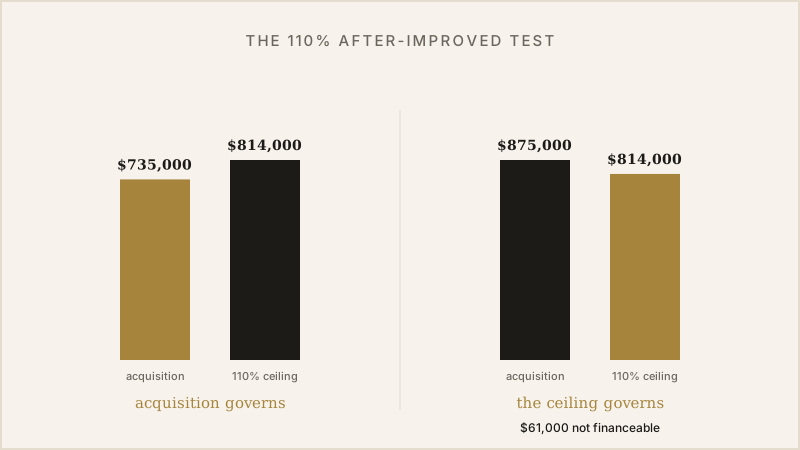
In the example above, the appraiser says the finished home will be worth $740,000. So:
- Acquisition cost: $735,000
- 110% of after-improved value: 110% x $740,000 = $814,000
- Lesser: $735,000. Your acquisition cost governs. The test never bites. Good.
Now watch it bite. Say you get excited and spec $250,000 of work on the same $600,000 house:
- Acquisition cost: $600,000 + $250,000 + $25,000 contingency = $875,000
- The appraiser still says the finished home is worth $740,000. 110% of that = $814,000
- Lesser: $814,000. The test governs now.
Roughly $61,000 of your plan is not financeable. You close the gap in cash, or you cut the scope.
Here is the sentence to carry out of this module:
You cannot renovate your way past what the finished house will be worth.
The 110% test is the program's brake on exactly that. It is also why the scope you build before you offer matters so much: a scope priced against real comparable sales is a scope the appraisal can carry. A wish list is not.
The contingency reserve
The contingency reserve is a financed cushion for the costs nobody can see until the walls are open.
It is the line people try to argue down, and it is the line you should leave alone. A house built in 1965 has opinions it has not shared with you yet: galvanized supply lines behind the tile, a panel that was modern during the Ford administration, rot under a shower pan that has been leaking politely for years.
Older stock needs a bigger cushion. That is not pessimism, it is arithmetic: more decades, more chances for something to have been done cheaply, and more layers of somebody else's improvement on top of it.
Confirm it for your file: the required reserve percentage, and what happens to money you do not spend, are set by program rules and lender practice, and we are not going to invent a number here. Ask your lender two specific questions: what contingency percentage is required on my file, and if we do not use it, does it reduce my principal or come back to me? Those are precise questions, and precise questions get precise answers.
If the reserve goes unspent, that is not waste. That is the surprise that did not happen.
How big can this loan get
Two different ceilings are now in play, and people mix them up constantly:
- The 110% after-improved test (above) is a value test.
- The FHA county loan limit is a hard dollar cap on the mortgage, set by where the house is.
The number: For case numbers assigned on or after January 1, 2026, the FHA high-cost ceiling is set at 150% of the $832,750 national conforming limit:3
Units 2026 high-cost ceiling One-unit $1,249,125 Two-unit $1,599,375 Three-unit $1,933,200 Four-unit $2,402,625 Los Angeles County sits at that ceiling, so in LA, a one-unit FHA loan tops out at $1,249,125. Confirm it for your file: limits are county-by-county and they change annually. Run your own county through HUD's official lookup4 rather than taking any figure, including ours, on faith. If you are not in LA County, your number is different.
Look at that four-unit line again: $2,402,625. Hold onto it. A 203(k) can be used on a two-to-four unit property, and almost nobody markets that. Module 6 is where it becomes a strategy.
Mortgage insurance, plainly
FHA insures your lender against loss. That insurance is the reason a lender will hand a first-time buyer a mortgage at 3.5% down on a house that currently has no kitchen.
You pay for it, in two pieces:
- An upfront premium: typically financed into the loan rather than paid at the table.
- An annual premium: collected monthly with your payment.
That is the trade, stated honestly: mortgage insurance is the price of the low down payment. It protects the lender, not you. Whether that trade is worth it depends on your alternative, and for most first-time buyers looking at fixers, the alternative is not buying at all.
Confirm it for your file: we are not quoting you premium factors, rates, or a monthly payment in this course, and you should be skeptical of anyone who quotes you one before seeing your file. Those numbers move, they depend on your specifics, and they are your lender's column. Ask for them in writing.
Value you created versus value you waited for
Most homebuying advice is a bet on the market. Buy, wait, hope the line goes up. Sometimes it does.
A renovation loan is a different proposition. Take the example: you are $735,000 into a house the appraiser says is worth $740,000 finished. That margin did not come from a forecast. It came from work: scoped, priced, financed, and completed.
That is forced appreciation: value you created. It is distinct from speculation: value you waited for.
Be honest about the distinction, because it cuts both ways:
- Forced appreciation is not free money. The example above nets a few thousand dollars on paper, not a windfall. Do not let anyone sell you a fixer as a lottery ticket.
- It is not risk-free. The appraisal can come in low. The contingency can get eaten. A contractor can walk. Module 5 covers what goes wrong, in detail and without flinching.
- But it is yours. You chose the scope. You controlled the work. The value tracks the work, not the weather.
The real prize is usually not the margin. It is that the house you could actually afford was the one nobody else could finance, and you could. That is what this loan buys you: access to the part of the market everyone else has to skip.
PAUSE & RECALL
Try it on a home.
Your repair wish list grows, but the expected finished value stays the same. What needs to happen next?
Compare your answer
Recheck the financing with your lender. You may need to reduce the scope or cover a gap; adding work does not automatically add financeable value.
References for this lesson
-
HUD, "203(k) Rehabilitation Mortgage Insurance Program." https://www.hud.gov/hud-partners/single-family-mortgage-programs-203k (retrieved 2026-07-16) ↩
-
Office of the Comptroller of the Currency, "FHA's 203(k) Loan Program," Community Developments Fact Sheet, June 2021. https://www.occ.gov/publications-and-resources/publications/community-affairs/community-developments-fact-sheets/pub-cd-fact-sheet-fha-203-loan-prog-jun-2021.pdf (full text retrieved 2026-07-16). Verbatim: the maximum is determined by either "(1) the value of the property before rehabilitation plus the cost of rehabilitation, or (2) 110 percent of the appraised value of the property after rehabilitation, whichever is less." ↩
-
HUD Mortgagee Letter 2025-23, "2026 Nationwide Forward Mortgage Loan Limits," December 11 2025, effective for case numbers assigned on or after January 1 2026. https://www.hud.gov/sites/dfiles/hudclips/documents/2025-23hsgml.pdf (full text retrieved and searched 2026-07-16) ↩
-
HUD, FHA Mortgage Limits lookup. https://entp.hud.gov/idapp/html/hicostlook.cfm (retrieved 2026-07-16). ML 2025-23 directs readers to HUD's Maximum Mortgage Limits page for the list of areas at the ceiling. ↩
Check yourself
Loading the knowledge check…
Sources and dates
Sources
- HUD Mortgagee Letter 2025-23, 2026 Nationwide Forward Mortgage Loan Limits. https://www.hud.gov/sites/dfiles/hudclips/documents/2025-23hsgml.pdf (VERIFIED, retrieved 2026-07-16)
- OCC, "FHA's 203(k) Loan Program," Community Developments Fact Sheet. https://www.occ.gov/publications-and-resources/publications/community-affairs/community-developments-fact-sheets/pub-cd-fact-sheet-fha-203-loan-prog-jun-2021.pdf (VERIFIED, retrieved 2026-07-16)
- HUD Mortgagee Letter 2024-13, Revisions to the 203(k) Rehabilitation Mortgage Insurance Program. https://www.hud.gov/sites/dfiles/OCHCO/documents/2024-13hsgml.pdf (VERIFIED, retrieved 2026-07-16)
- HUD, 203(k) Rehabilitation Mortgage Insurance Program. https://www.hud.gov/hud-partners/single-family-mortgage-programs-203k (VERIFIED, retrieved 2026-07-16)
- HUD, FHA Mortgage Limits lookup. https://entp.hud.gov/idapp/html/hicostlook.cfm (SUPPORTED, retrieved 2026-07-16)